For decades, the “Economic Machine” has told us a specific story: to be successful is to own; to be happy is to consume; and to move faster is to live better. But as we face the rising heat of a changing climate and the precariousness of a financialized world, that story is beginning to fray. We are discovering that the “engine” of our society isn’t the 1% or their stock portfolios—it’s us.
As we look toward a future of climate stability, the goal isn’t just to “survive” the heat; it is to thrive in a way that doesn’t cost the Earth. This requires a shift from being consumers of products to being citizens of a community.
The Power of the “Floor”
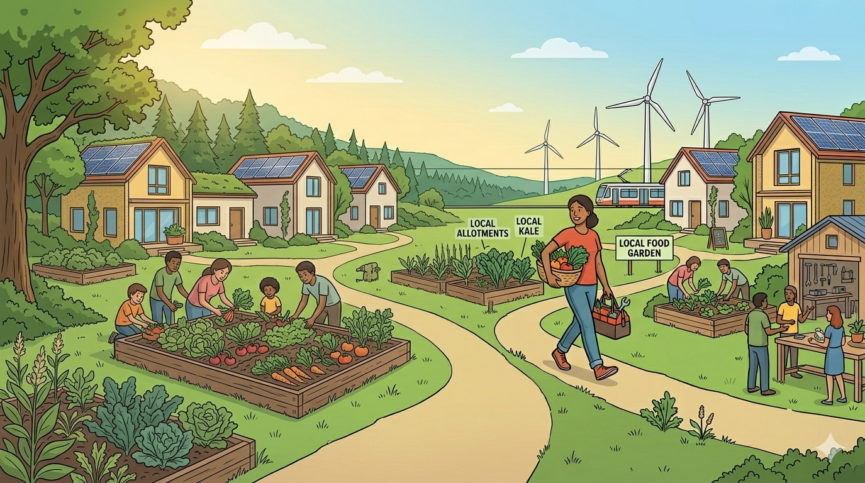
A stable life starts with a solid foundation. In our Transition Town vision, we move away from “work-to-survive” toward Universal Basic Services. Imagine a neighborhood where housing isn’t a speculative asset for an investor, but a high-performance, energy-efficient “Passive Solar House” that stays cool in a heatwave without a massive power bill. When our basic needs—health, transit, and shelter—are treated as a “Commons,” the pressure to constantly “earn more” begins to lift.
Trading Status for Experience
The old world rewarded the ownership of status symbols—the heavy SUV or the latest disposable tech. But a simpler, less consumptive lifestyle offers a different kind of luxury: Time.
By moving toward shorter work weeks and localizing our economies, we reclaim our hours. Instead of spending a Saturday at a shopping mall, we spend it at a community tool library or a repair café. This isn’t just “doing without”; it’s the return of the artisan. We trade the “cheap and breakable” for the “beautiful and repairable.” We find that a shared meal in a community garden provides more lasting dopamine than a new car ever could.
Resilience through Relationship
Climate change brings challenges like food shortages and extreme weather. A society obsessed with “every man for himself” is fragile in these moments. A “Social Society,” however, is resilient. When we know our neighbors, share our energy grids, and grow our own food, we aren’t just reducing our carbon footprint—we are building a safety net.
The transition is about moving from an economy of quantity (more stuff) to an economy of quality (more life). It is about realizing that we don’t need to own the world to enjoy it. By living more simply, we aren’t losing anything; we are finally gaining the freedom to be citizens of a world that can actually last.
Colin Marshall
March 2026